indians Together Nurturing Indias's Pluralistic ethos
we are committed to building a cohesive india, where every indian feels secure
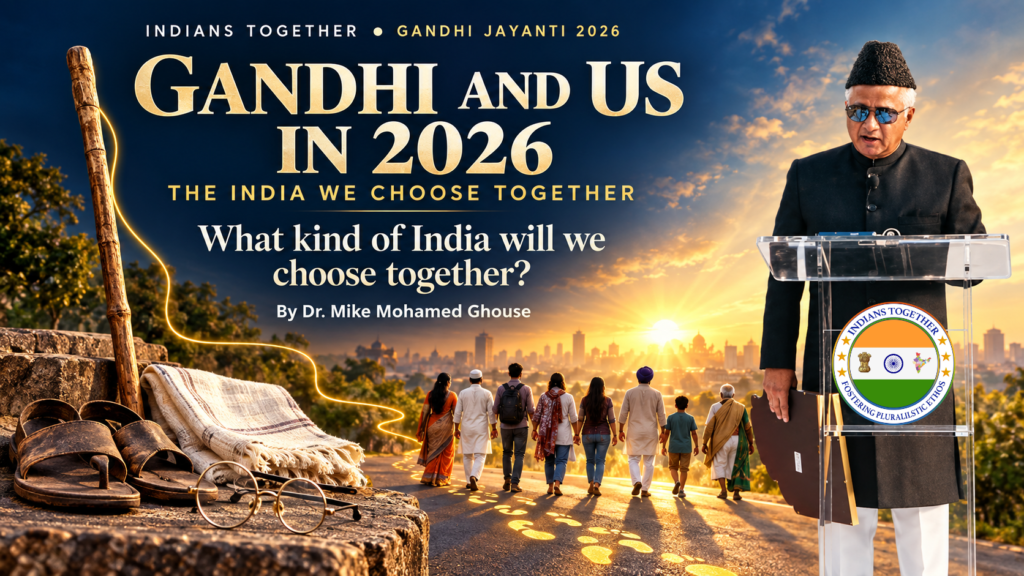
Gandhi and Us in 2026: The India We Choose Together
By Dr. Mike Mohamed Ghouse
At the Taj Mahal, a man near the front of a long queue offered me his place for fifty rupees. I was ready to accept. My children stopped me.
“No, Dad. That isn’t fair. We will wait.”
I had taken them to see one of India’s most magnificent monuments. Instead, they gave me a lesson about the India we build in ordinary moments. A small advantage for us would have meant disregarding everyone who had waited before us. My children saw that immediately. I felt ashamed that I had not.
On Gandhi Jayanti 2026, I return to that moment because Gandhi’s legacy is not confined to monuments, marches or the history we teach in school. It lives or fails in the choices we make when no one expects us to be heroic.
What kind of India do our daily choices create?
The Work Gandhi Left With Me
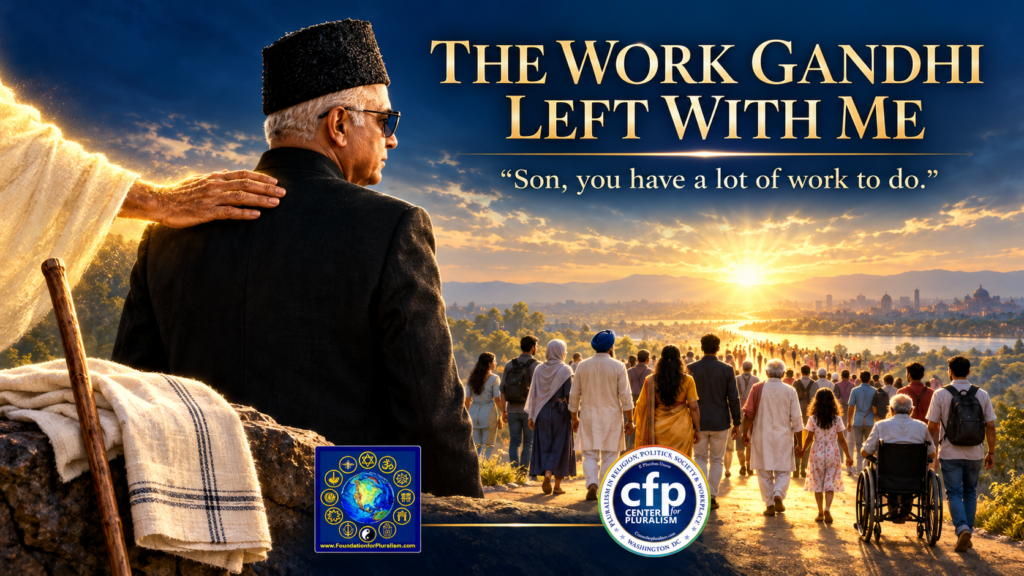
Gandhi has been one of the deepest influences on my life. In two dreams, one in the early 1970s and another in the early 1990s, he placed his hand on my back and said, “Son, you have a lot of work to do.”
I do not share this as a claim to special status. I share it because I understood those words as a responsibility: to help build cohesive societies where people do not fear one another because of religion, caste, race, ethnicity, language, culture, political belief or any other difference.
That responsibility helped give rise to the Foundation for Pluralism, which later became the Center for Pluralism. It also animates Indians Together. The aim is not to make every Indian think, worship or live alike. It is to help every Indian feel secure in being who they are.
Gandhi’s strength came from the same kind of commitment. Trained as a lawyer, he could have chosen comfort and professional success. Instead, he stood with ordinary people and accepted hardship alongside them. His nonviolence was not passive. It was disciplined resistance to injustice without surrendering conscience.
That is a demanding example to follow. It asks us not only to oppose what is wrong, but to examine what our opposition is turning us into.
What Our Children Learn From Us
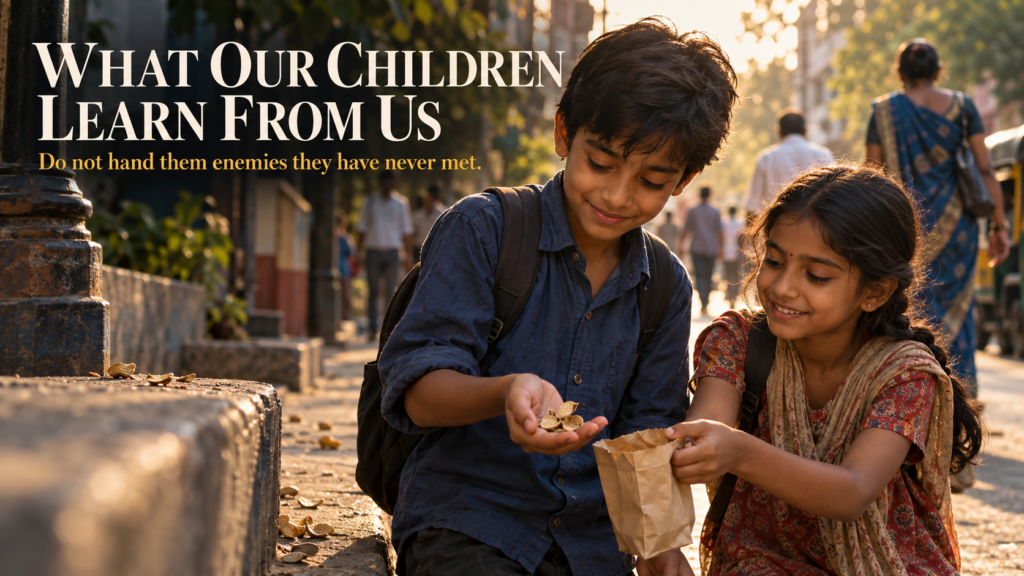
On another visit to India, I watched people walking along a street eating mungphali peanuts and dropping the shells on the ground. My children were eating peanuts too, but they held on to their shells.
The point is not that children raised in one country are better than children raised in another. The point is that children notice what their surroundings treat as normal. They learn from the habits adults practice, the shortcuts adults excuse and the standards communities are willing to uphold.
The queue at the Taj Mahal taught me the other side of that lesson. My children did not merely repeat something they had been told about fairness. They practiced it even when I was prepared to do otherwise.
If an environment can shape how a child treats a street or a queue, consider how powerfully it can shape how that child treats a neighbor.
No child is born with a list of communities to hate. Adults supply that list through warnings, jokes, accusations and fears passed from one generation to the next. A child hears that a Hindu, Muslim, Sikh, Christian, Jew, Dalit, Adivasi or someone from another region is a threat. Years later, we wonder why trust is so difficult to rebuild.
We should teach children history truthfully, including its violence and injustice. But we must not hand them enemies they have never met and battles they did not begin. The best inheritance we can offer them is the ability to recognize wrongdoing without losing sight of another person’s humanity.
My Father’s Lesson in a Time of Fear
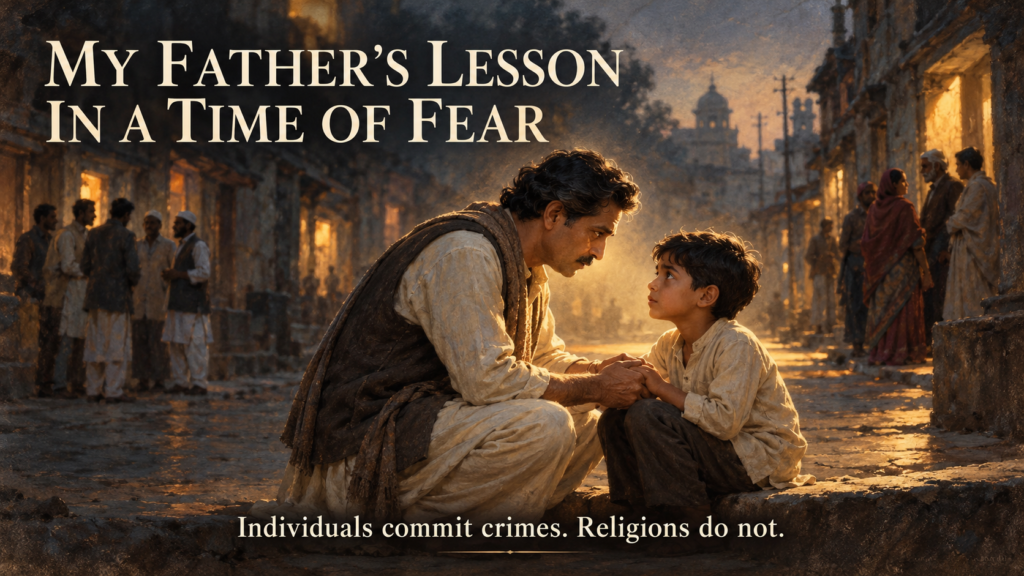
My father taught me this during communal violence in Jabalpur in the early 1960s. Hindus and Muslims were killed, and fear spread through entire communities. His insistence was simple: individuals commit crimes; religions do not.
A religion cannot be arrested, tried or imprisoned. A person who harms another person can and should be held accountable. When we shift blame from the wrongdoer to everyone who shares that person’s faith, we punish the innocent and make the next conflict more likely.
This is not an argument for overlooking violence. It is an argument for pursuing justice accurately. Every victim deserves to be seen, and every wrongdoer should be answerable for their actions. Neither goal is served by declaring an entire community guilty.
That lesson matters whenever anger runs high, whether the harm occurs in India or elsewhere in the world. We must be able to confront oppression without directing hostility toward people who did not commit it. Justice must remain just even when the suffering that calls for it makes us angry.
A Nation Begins With the Words We Use
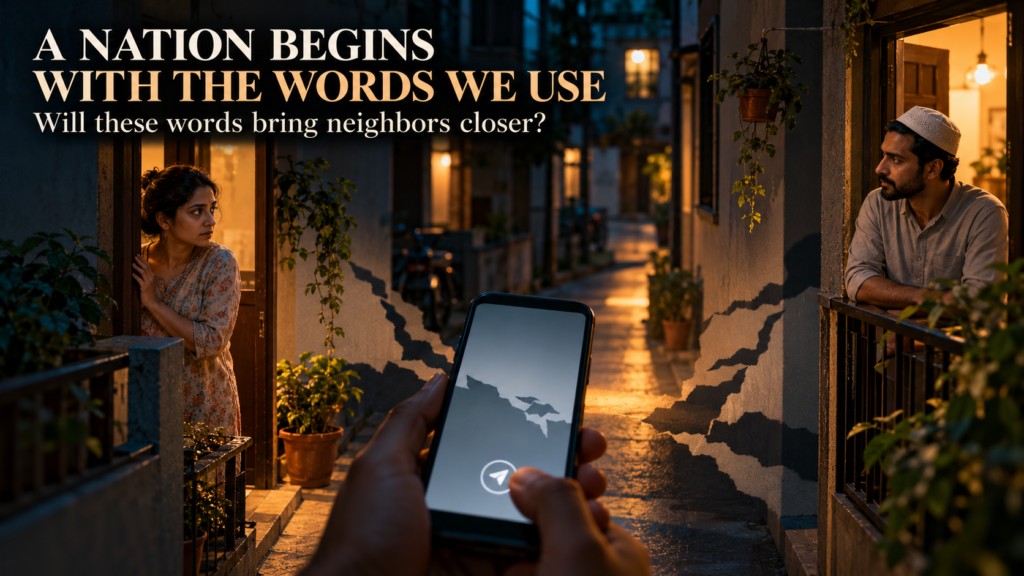
Physical violence rarely arrives without a story told about its targets. Someone first calls a neighbor dangerous. Someone repeats a stereotype until a whole community becomes suspect. Someone uses religion or patriotism to make cruelty sound like duty.
We can disagree fiercely about policy, faith and history without denying the dignity of the person across from us. Before speaking, posting or forwarding a message, we can ask: Will these words help solve a problem, or will they push neighbors further apart?
That question does not ask us to be silent about injustice. It asks us to be precise. Name the action. Identify the responsible person or institution. Defend those who are harmed. Do not turn a legitimate grievance into permission to despise millions of strangers.
We build the public language of India one conversation at a time, in our homes, schools, places of worship, workplaces and online spaces. Each of us contributes either to trust or to fear.
Pluralism Around the Family Table

For years, I have worked with interfaith couples and their families. When a son or daughter chooses a partner from another faith, culture, or race, parents often fear that their traditions will disappear. Families approaching marriage from very different religious backgrounds ask remarkably similar questions: Will my child abandon our faith? What will relatives say? How will the grandchildren be raised?
Fear speaks a common language.
The answer is not to ridicule parents or dismiss what matters to them. It is to keep everyone in conversation long enough to separate genuine concerns from imagined losses. Welcoming someone of another faith into a family does not require abandoning one’s own. It can deepen our understanding of our traditions while enlarging our circle of care.
This is Gandhi’s nonviolence in an intimate setting. It is the decision not to withdraw love when someone we cherish makes an unexpected choice. It is the patience to listen without demanding that another person erase their identity to earn a place at our table.
A cohesive India is not built only in Parliament or at public gatherings. It is built in relationships between parents and children, between neighbors, and between families learning how to make room for one another.
What We Can Do on Gandhi Jayanti 2026
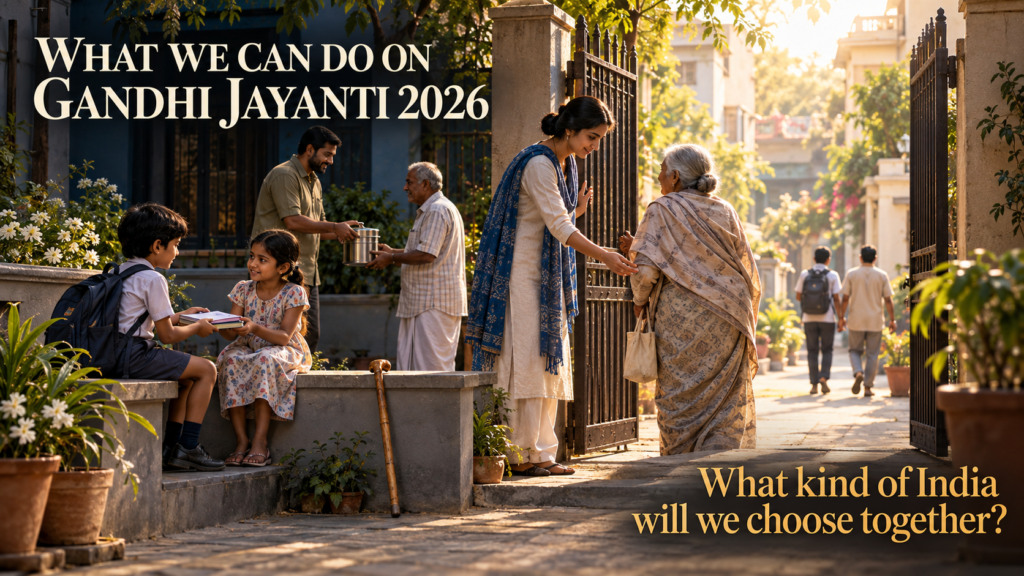
Gandhi’s birthday deserves more than a ceremony. Admiration must become action.
We can begin by refusing to pass prejudice to our children. We can correct a false accusation against another community, even when it comes from someone on our own side. We can challenge a harmful slogan without dehumanizing the person who repeats it.
We can turn faith into service: feed someone who is hungry, help a child learn, protect a threatened neighbor, or stand beside someone treated unfairly. We can make space for a family member’s difference without demanding conformity as the price of belonging.
None of these acts is too small. They are how an India of equal dignity is made real. The peace of others is connected to our own; no family can feel fully secure in a society where its neighbors live in fear.
A statue can remind us of Gandhi’s life, but it cannot live that life for us. His walking staff, spinning wheel and Salt March matter because they ask us to find the courage required in our own time.
When I remember his hand on my back and the words, “Son, you have a lot of work to do,” I no longer hear them as a message meant for me alone.
I hear them addressed to every Indian who wants a country where no one has to prove they belong.
On Gandhi Jayanti 2026, the question is not simply whether we admire Gandhi. It is whether our words, our families and our actions will carry his unfinished work forward.
What kind of India will we choose together?
Mahatma Gandhi inspires Mike Ghouse
Dr. Mike Ghouse is the President and founder of the Center for Pluralism and director of the World Muslim Congress. He is an Interfaith Wedding Officiant for InterfaithMarriages.org and a Muslim Wedding Officiant. He is a Muslim, Pluralist, activist, speaker, author, and social scientist. He is also a member and supporter of Muslims for Progressive Values (MPVUSA). More on Google